How the Strait of Hormuz closed and oil prices jumped
By PetrolCast4 min read
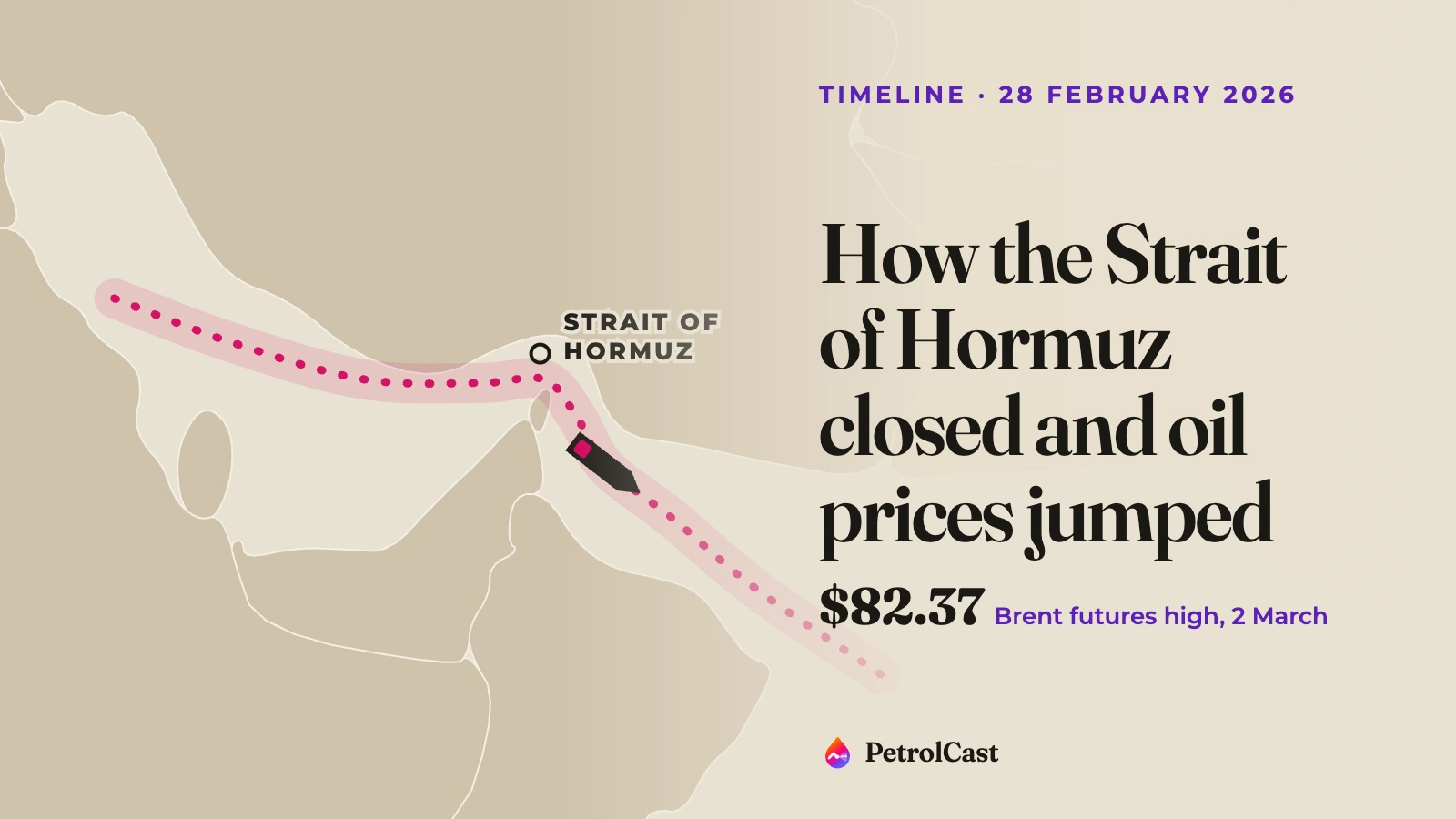
The war that began on 28 February 2026, when the United States and Israel struck Iran, shut the main sea route out of the Gulf within three days. In 2025 about 20 million barrels a day of crude and oil products passed through the Strait of Hormuz, about 25% of all oil traded by sea, according to the IEA. This is how the Strait of Hormuz closure unfolded and what it did to oil prices, from the Saturday the strikes began to the first full day of trading on Monday 2 March.
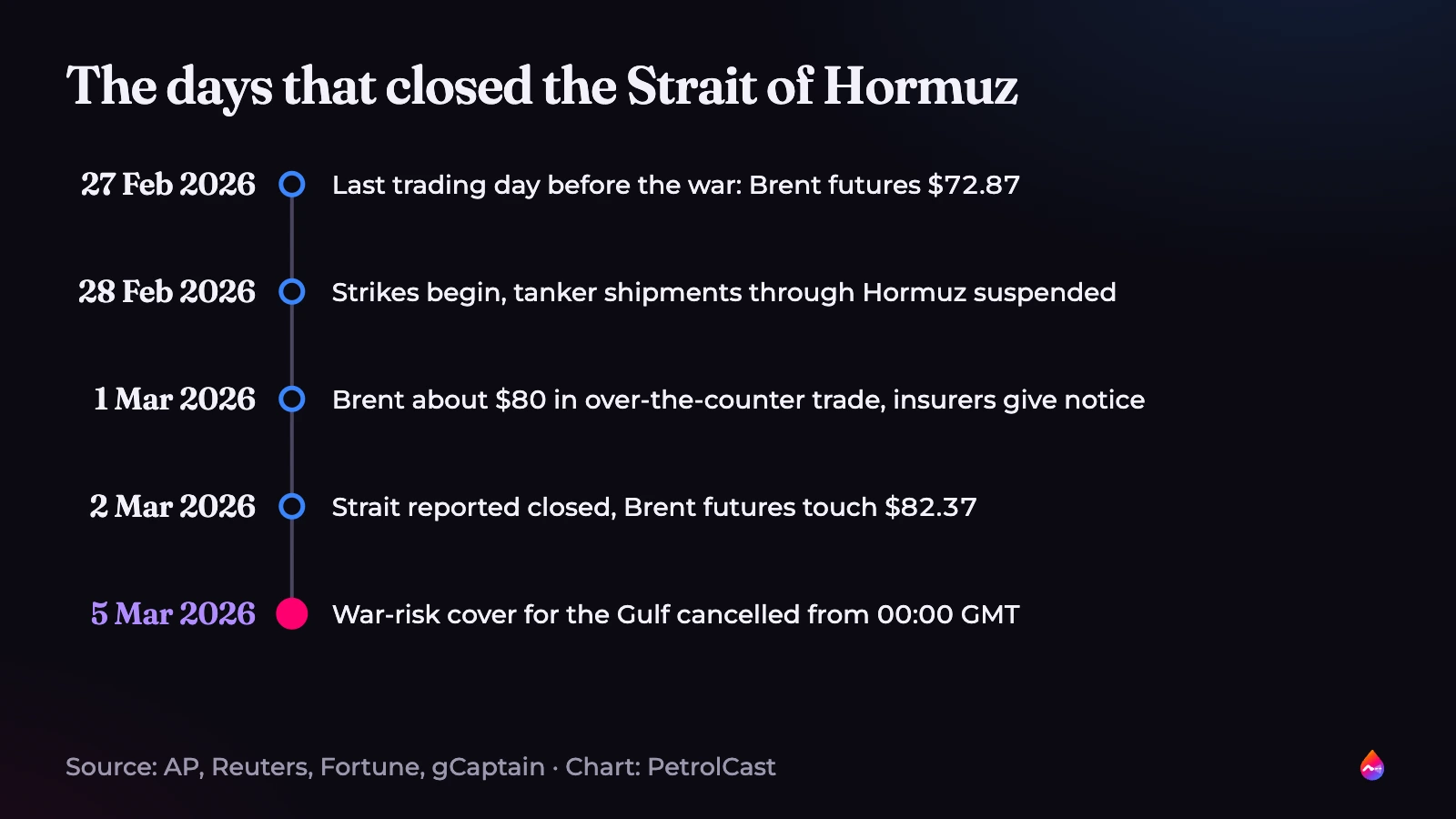
Three days in the Gulf
Friday 27 February
The last normal day. Brent futures stood at $72.87 a barrel, AP reported, and the EIA's Brent spot price, the price of physical cargoes, was $71.32. Both already carried weeks of nerves about a possible war.
Saturday 28 February
The United States and Israel launched strikes on Iran, and Iran fired missiles and drones at Israel and at US military sites in Bahrain, Kuwait and Qatar, AP reported. The shipping industry reacted the same day. Tanker owners, oil majors and trading houses suspended shipments through Hormuz, Greece advised its ships to avoid the area and Maersk suspended crossings.
Oil exchanges are closed at weekends, so there was no price that day. The question was what Monday would bring.
Sunday 1 March
Iran's Revolutionary Guards said they had struck three tankers. Iran's foreign minister said Iran had no intention of closing the strait “at present”. Traders did not wait to see. In over-the-counter trade, Brent rose about 10% to around $80 a barrel, Fortune reported, citing Reuters.
The same day several of the big mutual insurers that cover ships gave 72 hours' notice that they would cancel war-risk cover for Iranian waters, the Gulf and the Gulf of Oman from 00:00 GMT on 5 March, gCaptain reported. From then on, cover had to be bought ship by ship, at a price set for the danger.
Monday 2 March
An official of the Revolutionary Guards was reported as saying the strait was closed and that ships trying to pass would be fired on. On the first full day of trading, Brent futures touched $82.37, their highest since January 2025, and settled 6.7% higher. European gasoil futures, the benchmark for diesel in Europe, jumped 18%, Reuters reported.
Also on 2 March, Saudi Aramco shut its Ras Tanura refinery as a precaution after a drone strike in the area, and QatarEnergy suspended LNG production at Ras Laffan after what Qatar said was an Iranian drone attack.
The rest of the week
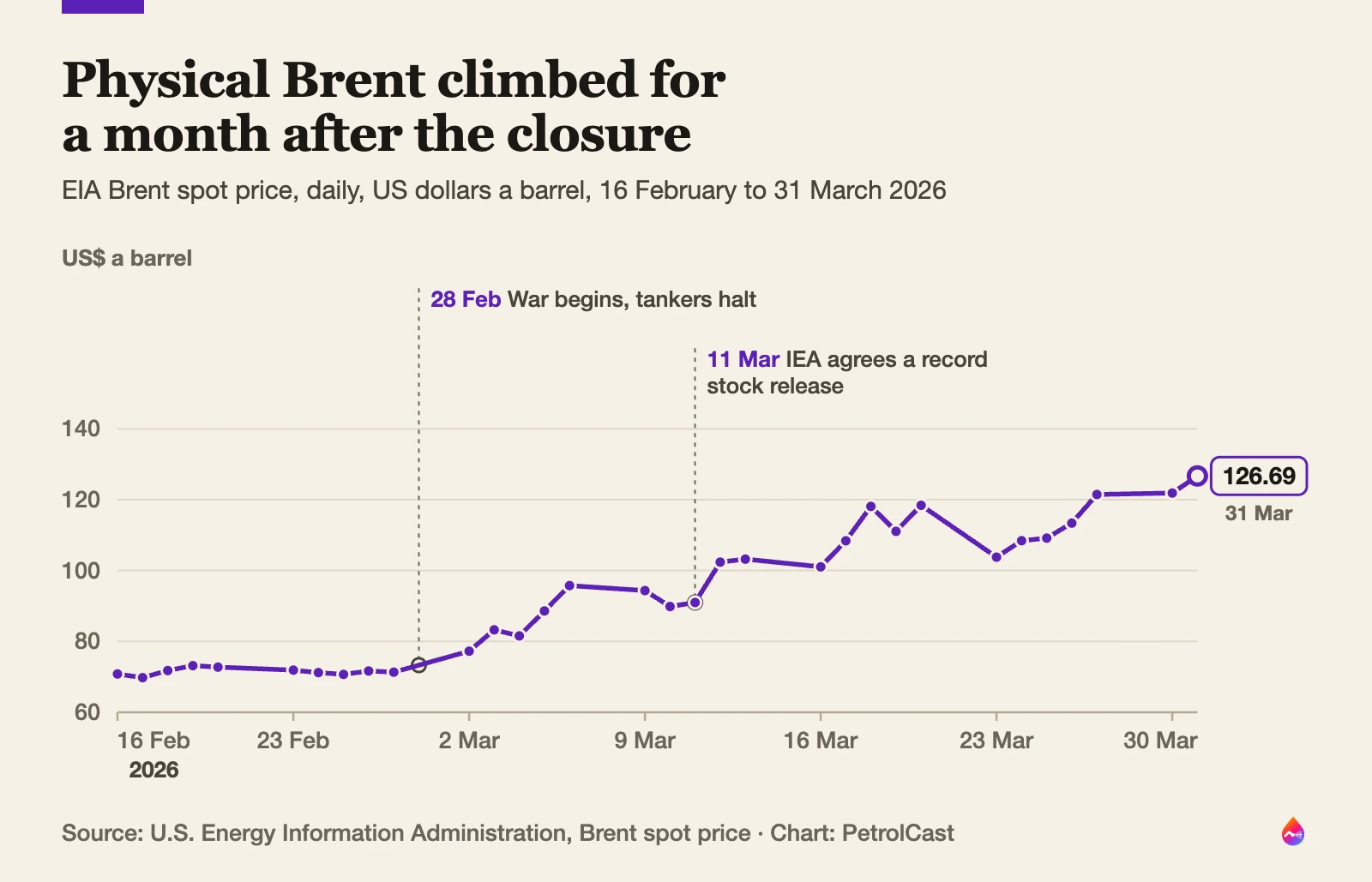
The EIA's spot price rose more slowly at first. It was $77.24 on 2 March, then $83.28 on 3 March and $95.74 on Friday 6 March. Its average for the week of 2 March was $85.28, against $71.36 the week before. The two Brents told slightly different stories that Monday. Futures touched $82.37 during the day, while the EIA's spot assessment for 2 March was $77.24. A month later the order had flipped, and physical cargoes were selling far above futures. By 11 March the IEA said exports of crude and oil products through the strait were below 10% of their level before the conflict.
What it meant at the pump
The 18% jump in gasoil against 6.7% for crude on 2 March was the first sign of what drivers would feel most. Gulf refineries export large volumes of diesel and jet fuel, so when the strait shut, those fuels rose faster than crude. Freight and insurance costs rose as well, and both are part of what an importing country pays for each cargo.
Import costs rose almost everywhere at once, because so much of the world's oil had stopped moving. Countries where fuel is priced by the market saw it first in wholesale prices and then at the pump within weeks. Countries that set prices by formula took it in at their next official revision. In the United States, the diesel price eventually reached a record $6.52 a gallon on 22 September, AAA said, and you can follow it on our US diesel page.
Our compare page shows how far petrol and diesel moved in each country in the weeks after the closure, and the news page lists the events behind each change.
More from the blog
All posts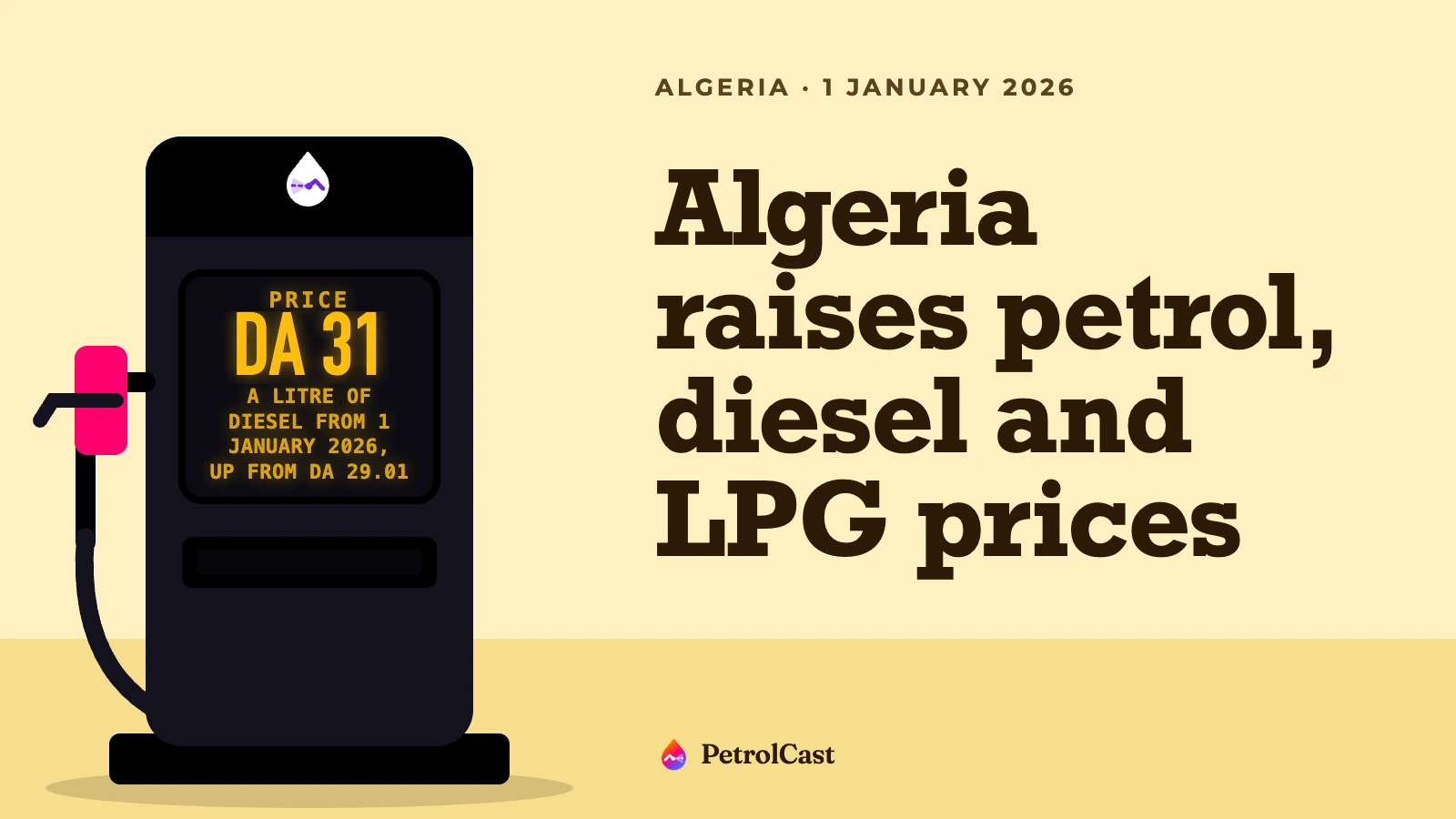
Algeria raises petrol, diesel and LPG prices for 2026
Algeria fuel prices for 2026 took effect on 1 January: petrol DA 47, diesel DA 31 and LPG DA 12 a litre. What changed and what the ministry said.
PetrolCast3 min read
Saudi Arabia raises diesel to SAR 1.79 a litre for 2026
The Saudi diesel price for 2026 rose to SAR 1.79 a litre on 1 January. Why diesel moves once a year, and why petrol and oil prices did not change it.
PetrolCast4 min read
How oil lost $28 in June 2026 as Hormuz reopened
Oil prices fell through June 2026 as an interim US-Iran deal reopened Hormuz. The EIA's Brent spot price, ship counts and pump prices, week by week.
PetrolCast4 min read
Forecasts are estimates for information only, not financial advice.