Pakistan raises petrol by Rs55 and moves to weekly reviews
By PetrolCast6 min read
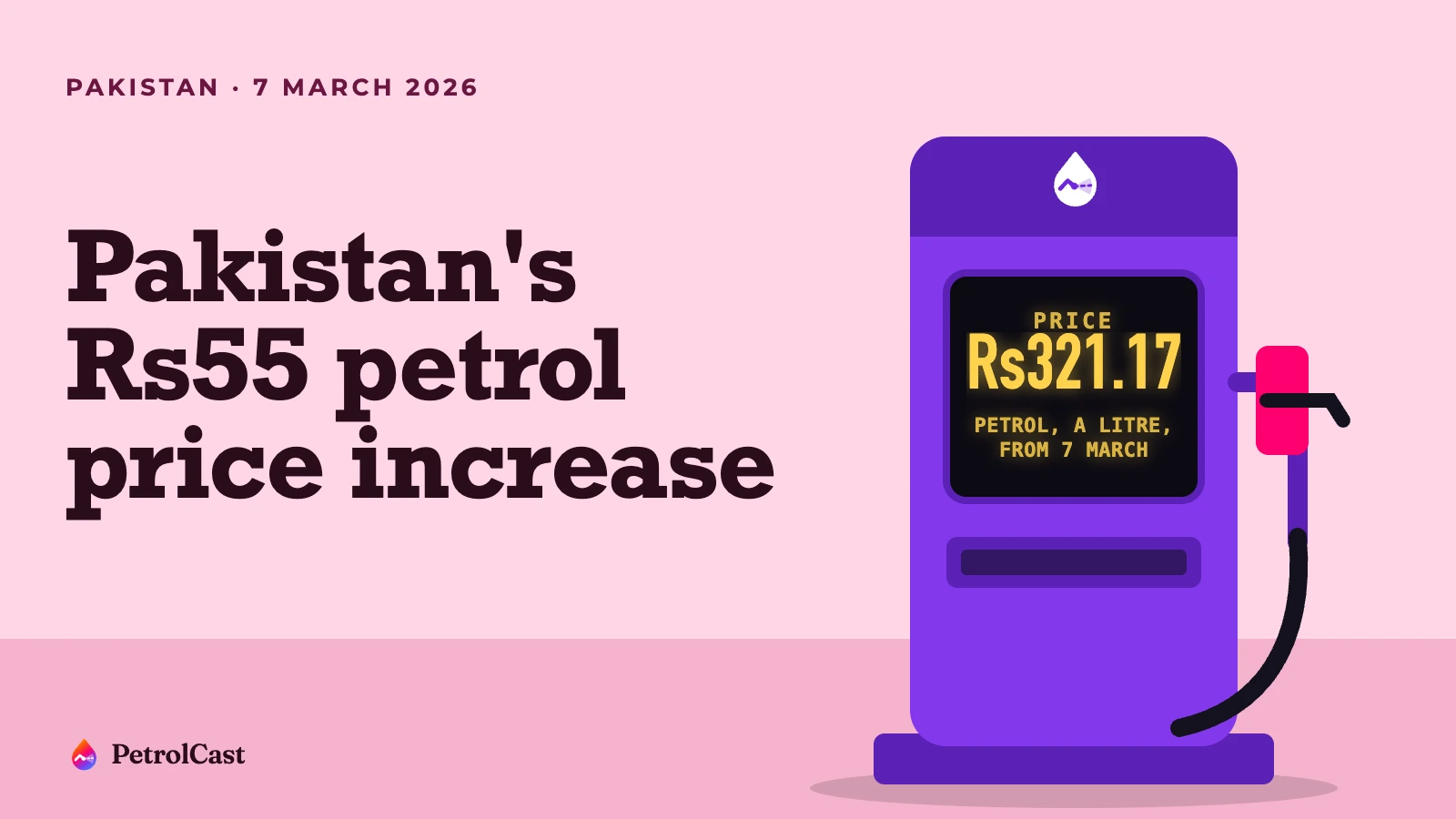
At the pump on Saturday 7 March 2026, Pakistani drivers found petrol at Rs321.17 a litre. On Friday it had been Rs266.17. That Rs55 petrol price increase, matched by Rs55 on high-speed diesel, was the first big piece of the 2026 oil shock to reach Pakistan's pumps, and it came with a new rule. Prices would now be set for a week at a time instead of a fortnight. Two days later the Prime Minister asked the country to burn less fuel. This guide goes through all three changes, with the official price that applied on each date.
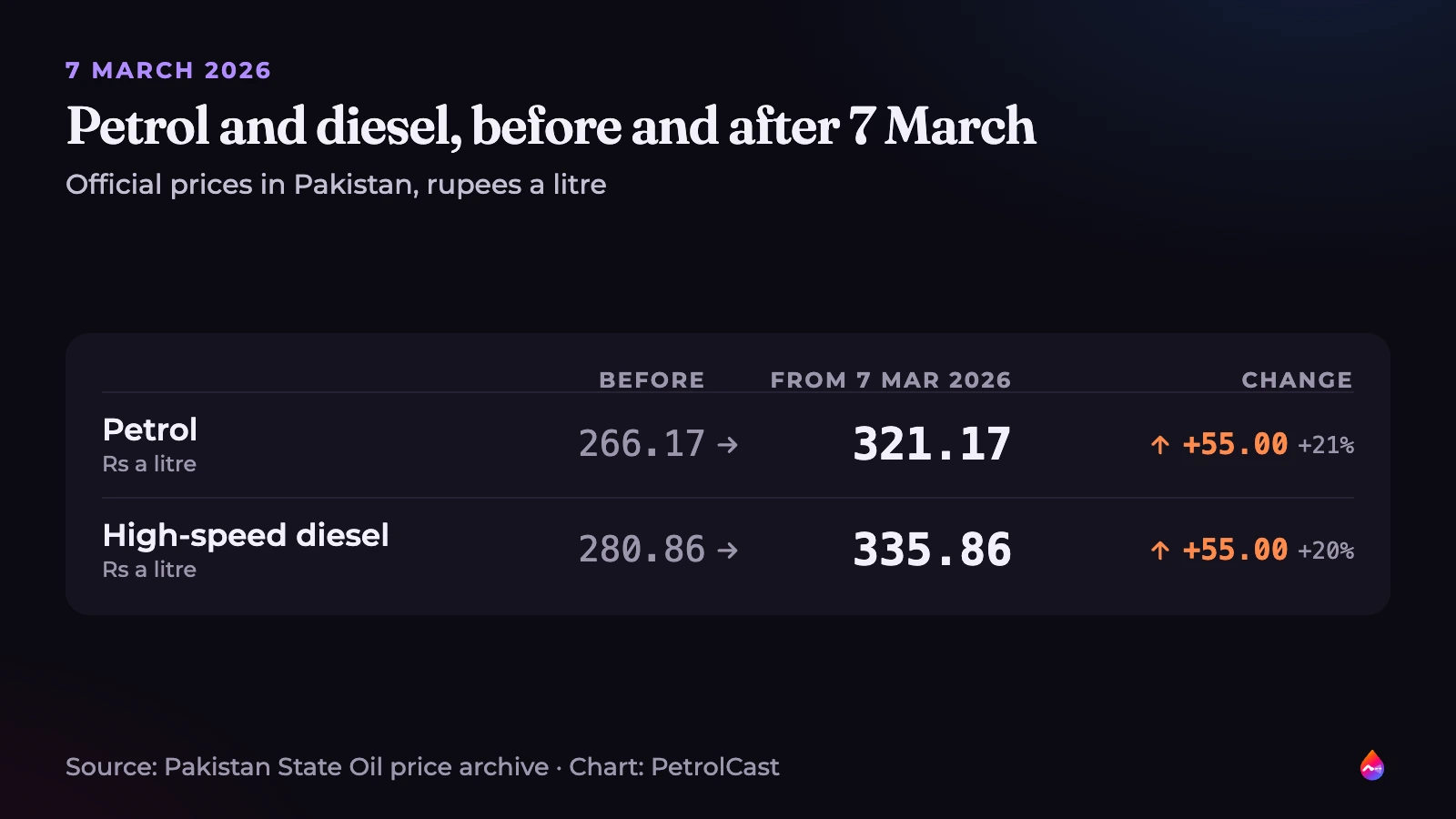
What changed on 7 March
The rise was decided at a meeting chaired by Deputy Prime Minister Ishaq Dar on Friday 6 March, and announced by Mr Dar and Petroleum Minister Ali Pervaiz Malik at a press briefing. It applied from midnight. Officials pointed to rising international oil prices and regional tensions that were pushing up import costs, and said the new prices would apply for seven days only (Profit).
Behind those tensions was the war that began on 28 February 2026, when the United States and Israel struck Iran. Tanker owners and traders suspended shipments through the Strait of Hormuz that day. The World Bank's monthly average for Brent crude rose from $71.1 a barrel in February to $103.7 in March (World Bank commodity prices).
It was the second rise in a week. On 1 March petrol had gone up Rs8, from Rs258.17 to Rs266.17, and diesel Rs5.16, from Rs275.70 to Rs280.86, according to Pakistan State Oil's price archive (PSO). The year had begun lower still. Petrol was cut by Rs10.28 to Rs253.17 on 1 January (Dawn), and diesel stood at Rs257.08. By 7 March a litre of petrol cost Rs68 more than on New Year's Day, and a litre of diesel Rs78.78 more. Diesel's new price was also the highest in our records of Pakistan's official prices, above the Rs329.18 of 16 September 2023. Petrol, at Rs321.17, was still below its own high of Rs331.38, set on the same day in 2023.
What Rs55 a litre means for a fill-up
In rupees the rise was the same for both fuels. As a share of the old price it was about a fifth, 20.7% on petrol and 19.6% on diesel. This is what it did to some ordinary fill-ups.
- Filling a motorcycle with 10 litres of petrol cost Rs3,211.70 instead of Rs2,661.70, so Rs550 more.
- A car taking 40 litres cost Rs12,846.80 to fill instead of Rs10,646.80, or Rs2,200 more.
- A pickup or tractor taking 50 litres of diesel cost Rs16,793 instead of Rs14,043, Rs2,750 more.
- Over four weeks, a rider who buys 10 litres a week paid about Rs2,200 more, and a family that fills a 40-litre car every week about Rs8,800 more.
Those sums use the official price per litre, the figure the government notifies.
Why the price began changing every week
Until March the government reviewed petrol and diesel prices every 15 days, with new prices on the 1st and the 16th of the month. From 7 March each price was set for seven days, and the next review came a week later. Arab News later described it as a switch to weekly adjustments made after the fighting began in late February (Arab News).
For drivers, a weekly review means a change in world prices reaches the pump sooner, whether it is a rise or a fall. It also means checking the price more often. Every change in this period took effect from midnight, so filling up before midnight meant paying the old price. In the first three weekly reviews after 7 March, on 14, 21 and 28 March, petrol and diesel did not move, while kerosene went up every week. On 3 April Prime Minister Shehbaz Sharif said the government had spent Rs129 billion over the previous three weeks to cushion prices (Dawn).
The weekly prices in March
| Price from | Petrol | Diesel | Kerosene |
|---|---|---|---|
| 1 March | 266.17 | 280.86 | 188.73 |
| 7 March | 321.17 | 335.86 | 318.81 |
| 14 March | 321.17 | 335.86 | 358.01 |
| 21 March | 321.17 | 335.86 | 428.74 |
| 28 March | 321.17 | 335.86 | 433.40 |
| 3 April | 458.41 | 520.35 | 467.48 |
All figures are rupees a litre, from PSO's price archive. Kerosene more than doubled in four weeks, from Rs188.73 on 1 March to Rs433.40 on 28 March.
What happened next
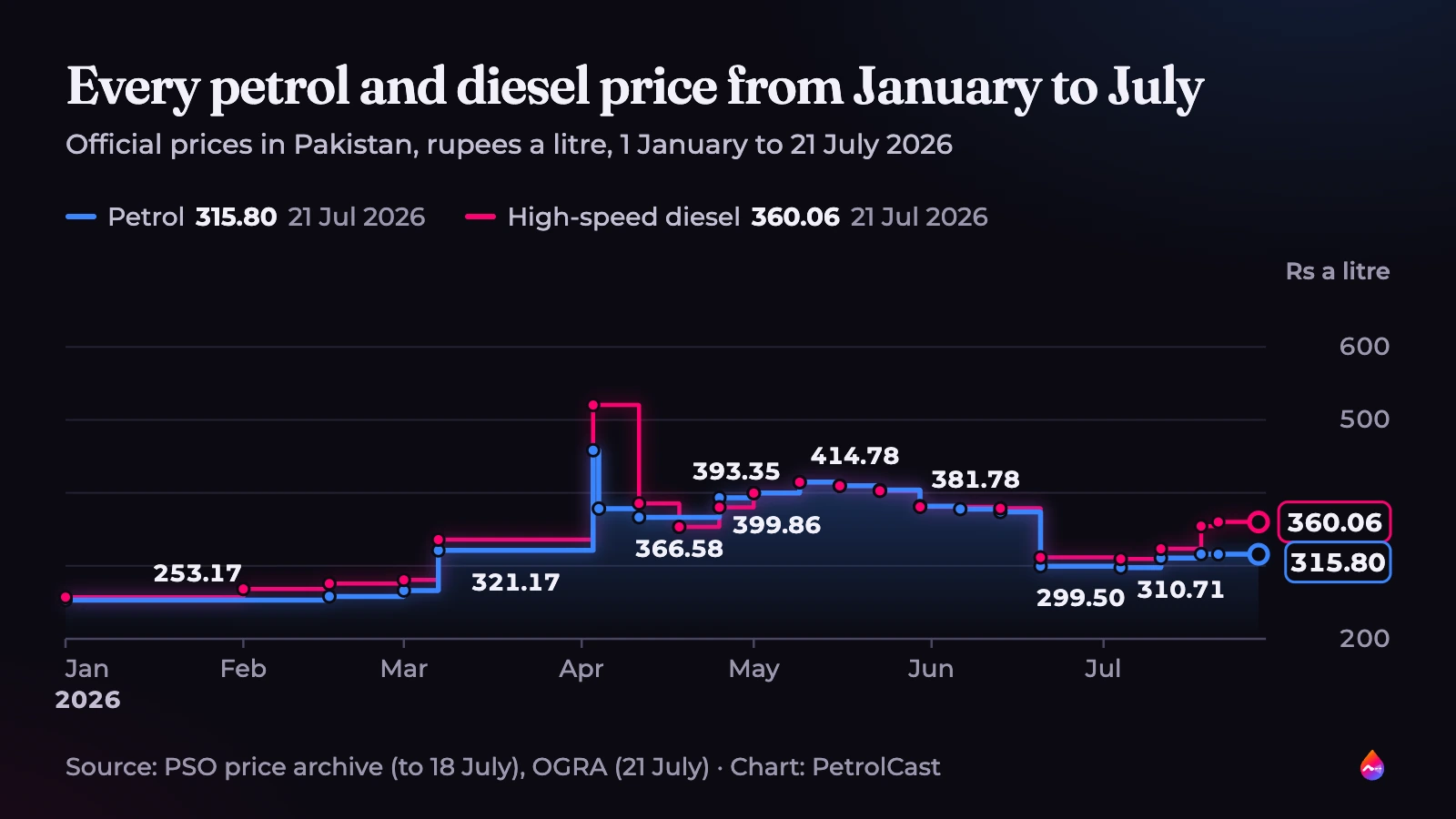
The weekly system carried Pakistan through the sharpest swings of the year. On 2 April the government raised petrol to Rs458.41 a litre, a record that lasted one day, before an Rs80 cut in the petroleum levy brought it down to Rs378.41 from 4 April. Petrol reached Rs414.78 on 9 May, fell to Rs297.53 on 4 July and was Rs316.15 on 18 July. Diesel's path was steeper still. It fell to Rs353.42 on 18 April, climbed to Rs414.58 on 9 May and dropped to Rs309.50 on 4 July. Not every review moved the price. On 27 June, for example, petrol and diesel stayed at Rs299.50 and Rs311.47.
On 17 July Mr Malik announced that the Oil and Gas Regulatory Authority (OGRA) would set prices daily (Arab News). Our records of OGRA's daily notices begin on 21 July, when petrol was Rs315.80 and diesel Rs360.06.
The fuel-saving measures of 9 March
On Monday 9 March Prime Minister Shehbaz Sharif announced measures to cut how much fuel the country used (Profit). The main ones were these.
- Offices in the public and private sectors were to open four days a week and keep half their staff working from home. Banking, agriculture and industry were exempt.
- Schools took a two-week break, and universities and colleges moved their classes online.
- Fuel allowances for official vehicles were cut by half for two months, with ambulances and public buses exempt, and government departments were told to stop 60% of their vehicle use.
- Government offices stopped buying vehicles, furniture and air conditioners, and departmental spending was cut by 20%.
- Cabinet members gave up their salaries and parliamentarians took a 25% pay cut. Ministers and officials were barred from foreign trips unless essential.
- Meetings were to be held online or on government premises, and official dinners and iftar events were banned.
The fuel allowance cut was the only measure in the announcement with a stated end date. The government also warned of legal action against anyone hoarding fuel. None of these steps touched the pump price. They were aimed at the amount of fuel the country burned while every imported cargo cost more.
Where to check the price now
Pakistan's fuel price is still set by the state. It is made up of the cost of the fuel itself, duties, the margins of oil companies and dealers, and the petroleum levy, a fixed amount per litre that the government adds. At the start of the year the levy was Rs82 a litre on petrol and Rs78 on diesel (Dawn). The levy has moved since. By early April, Dawn reported, it stood at Rs105 a litre on petrol and Rs55 on diesel, before the changes of 2 and 4 April (Dawn). Our page on how Pakistan's prices are set explains each part.
Since 21 July OGRA has issued a new price on most days, and our petrol page and diesel page show each official price with its source. On 24 November, in OGRA's latest notice in our records, petrol was Rs319 a litre, a little below the price set on 7 March, and diesel Rs357, still above it.
Petrol in Pakistan: Rs 312 per litre, the official price since
More from the blog
All posts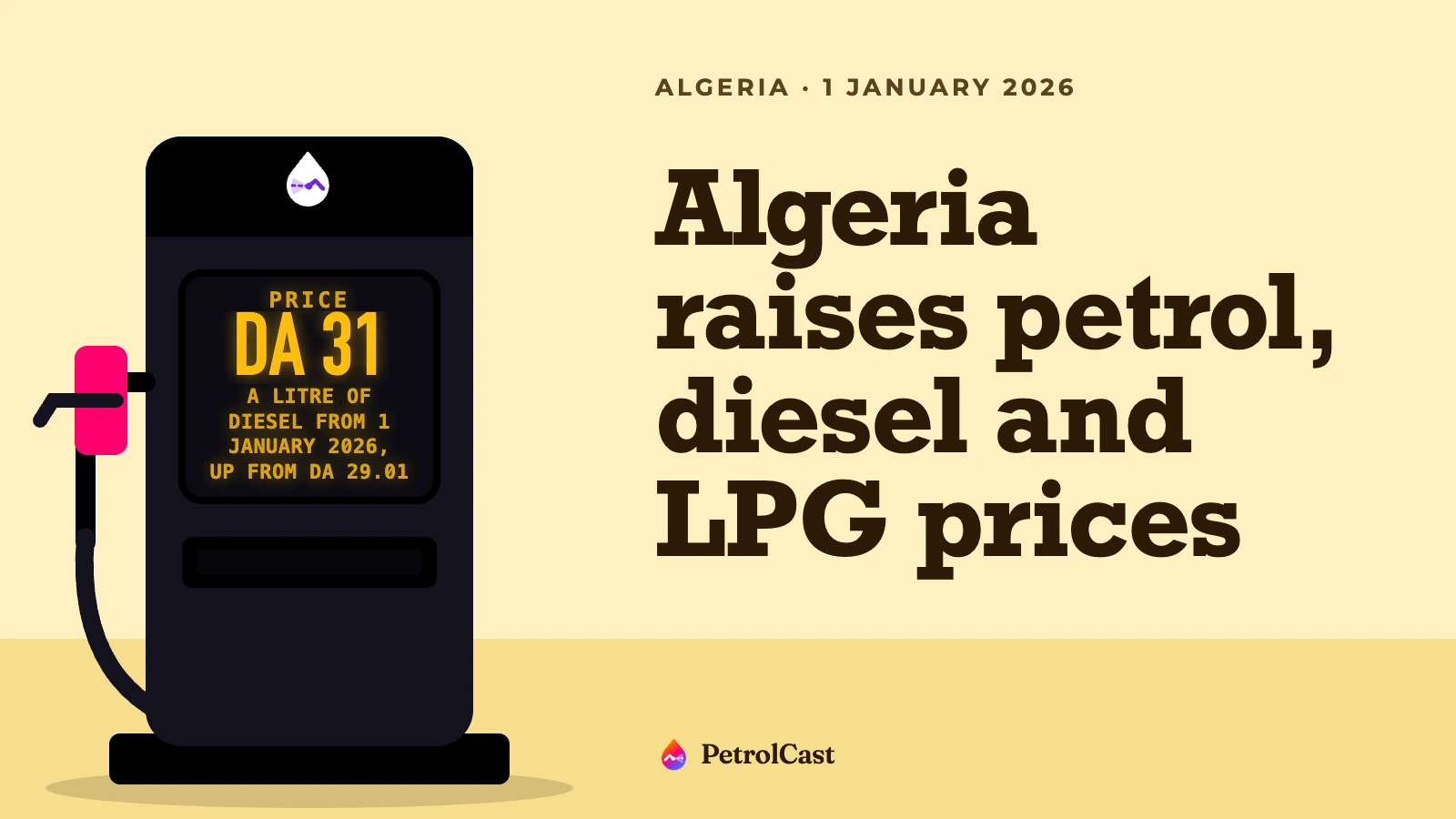
Algeria raises petrol, diesel and LPG prices for 2026
Algeria fuel prices for 2026 took effect on 1 January: petrol DA 47, diesel DA 31 and LPG DA 12 a litre. What changed and what the ministry said.
PetrolCast3 min read
Saudi Arabia raises diesel to SAR 1.79 a litre for 2026
The Saudi diesel price for 2026 rose to SAR 1.79 a litre on 1 January. Why diesel moves once a year, and why petrol and oil prices did not change it.
PetrolCast4 min read
How oil lost $28 in June 2026 as Hormuz reopened
Oil prices fell through June 2026 as an interim US-Iran deal reopened Hormuz. The EIA's Brent spot price, ship counts and pump prices, week by week.
PetrolCast4 min read
Forecasts are estimates for information only, not financial advice.