Seven facts about the IEA's 400 million barrel oil release
By PetrolCast4 min read
On 11 March 2026, eleven days into the war that began on 28 February 2026, when the United States and Israel struck Iran, the 32 member countries of the International Energy Agency agreed to make 400 million barrels of emergency oil available. It was the agency's answer to the closure of the Strait of Hormuz, and by mid-October most of that oil had been delivered. These seven facts cover what the emergency oil stock release was, who supplied it, and what it could and could not do for prices.
Seven facts
1. It was the largest release in the IEA's history
The decision was unanimous, the IEA said. It was only the sixth collective action since the agency's first in 1991, after others in 2005, 2011 and twice in 2022. At 400 million barrels it was more than double the 182.7 million barrels of 2022.
2. It answered an almost complete stop
When members agreed, the IEA said exports of crude and oil products through the Strait of Hormuz were below 10% of their level before the conflict. In 2025 about 20 million barrels a day had passed through the strait, about a quarter of all oil traded by sea. In other words, at least 18 million barrels a day were missing.
3. Governments in the Americas gave the most
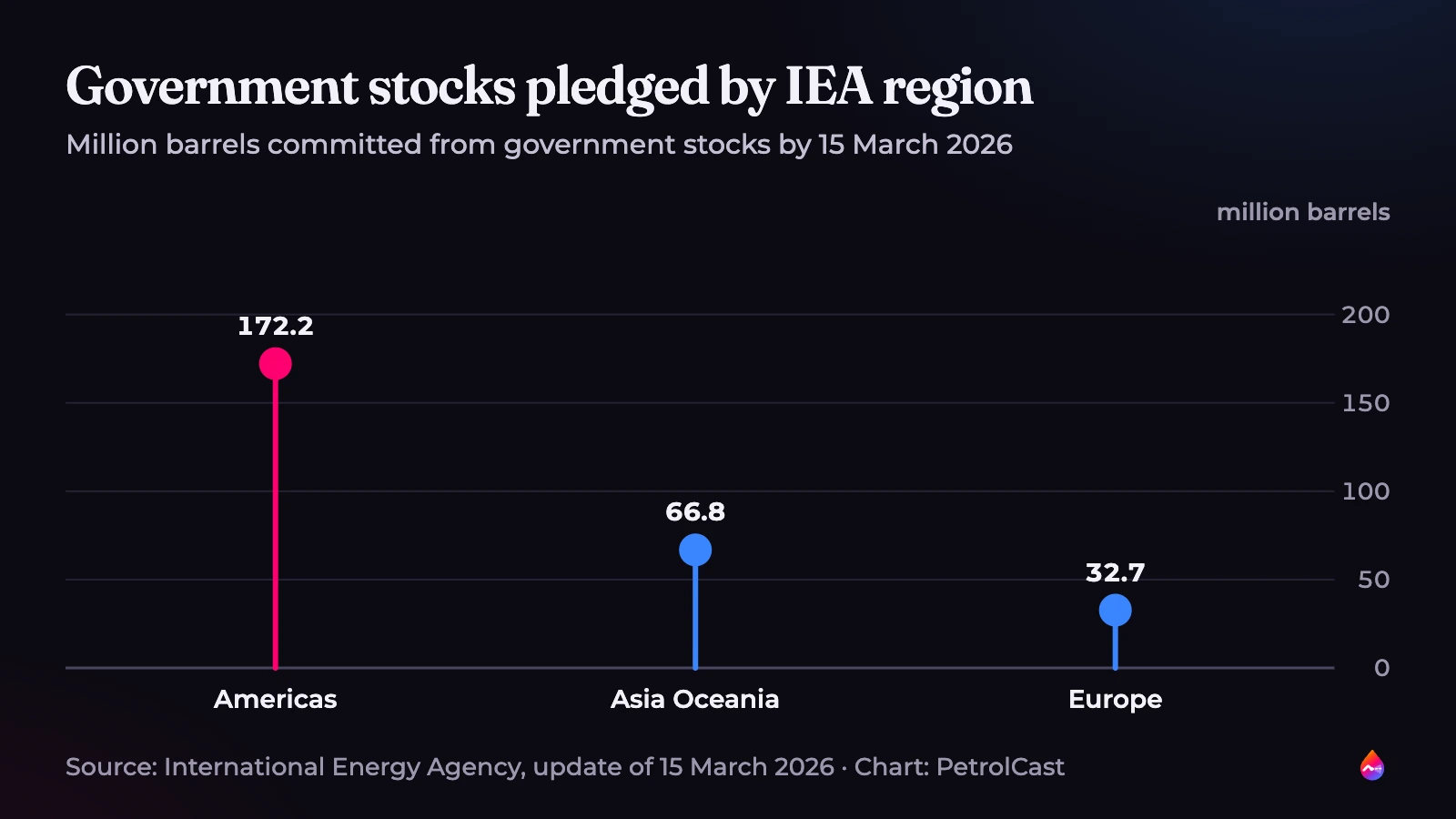
By 15 March members had committed 271.7 million barrels from government stocks: 172.2 million in the Americas, 66.8 million in Asia Oceania and 32.7 million in Europe, the IEA's update shows. Most of the rest came from stocks that oil companies are required to hold.
4. The United States lent its oil
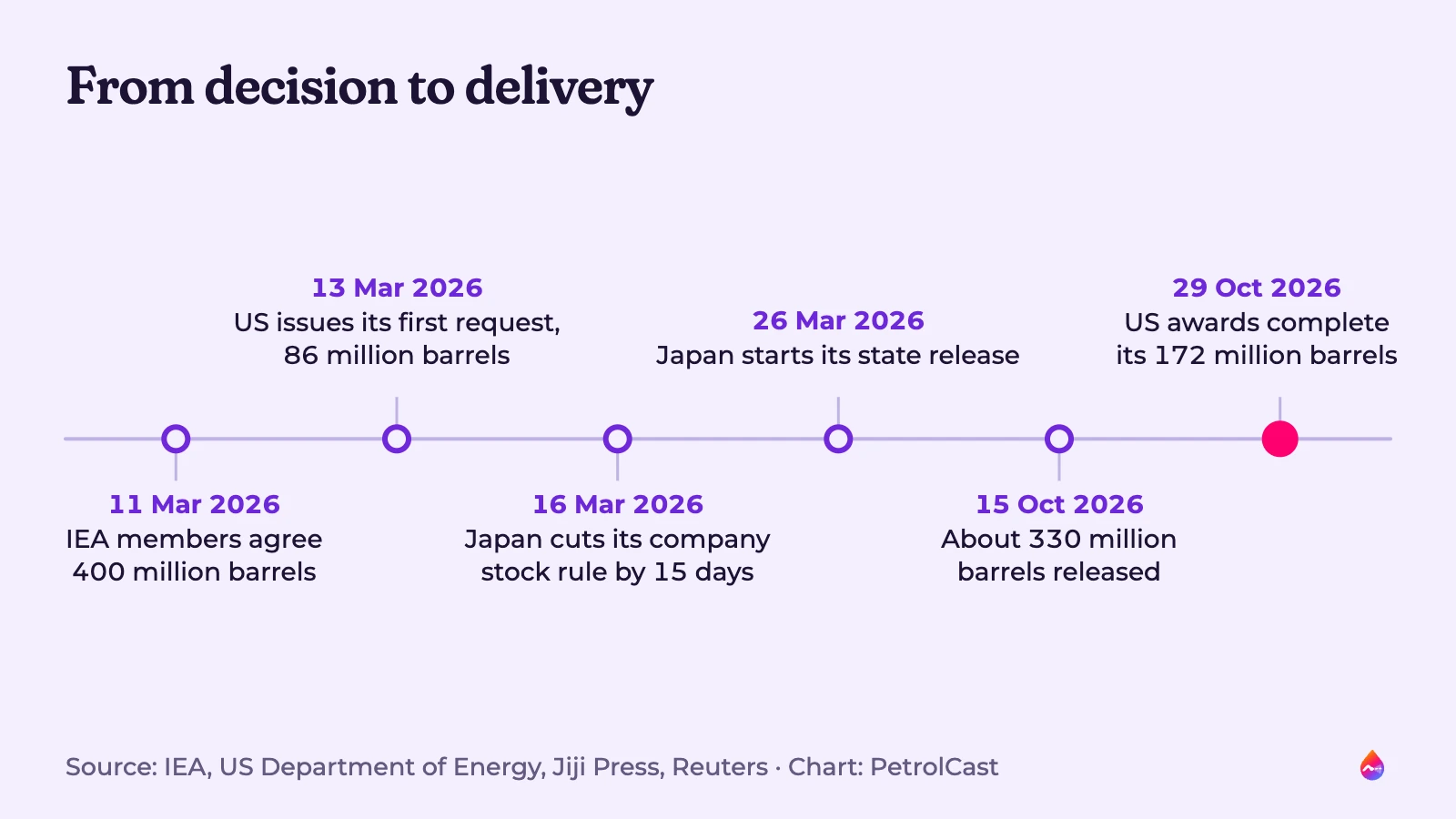
The US committed 172 million barrels from its Strategic Petroleum Reserve, the government's emergency store of crude oil, as exchanges. An exchange is a loan: companies take the oil now and pay it back later with extra barrels. The Department of Energy issued its first request, for 86 million barrels, on 13 March (DOE). On 29 October it said its final awards had completed the 172 million, and that more than 216 million barrels would come back to the reserve, including 44 million barrels of premium, with returns beginning early next year (DOE).
5. Japan opened its state reserve for the first time since 2022
On 16 March Japan cut the amount of oil its companies must hold by 15 days' worth. On 26 March it began releasing state reserves equal to 30 days of consumption, about 8.5 million kilolitres, or about 53 million barrels, its first state release in four years, Jiji Press reported. Japan has more reason than most to hold reserves. Exports from the Gulf make up 80% to 90% of the oil brought into Japan, Fortune reported.
6. Delivery took months
Emergency oil does not arrive overnight. It has to be sold or lent, loaded and shipped. By 15 October about 330 million barrels had been released under the action, the IEA said, according to Reuters. That is about 82% of the 400 million, seven months after the decision. The pace matters, because oil that has been promised but not yet delivered does nothing for a refinery that needs crude this week.
7. It slowed the rise in prices, and could not stop it
Four hundred million barrels sounds enormous. Set against the roughly 20 million barrels a day that normally passes Hormuz, it covers about 20 days. The EIA's Brent spot price was $90.98 a barrel on the day of the decision and still climbed to $138.21 on 7 April, its high for the year. Stock releases replace part of the oil that is lost and calm the futures market, but a few weeks of supply cannot stand in for a route that stays shut for months.
What it means from here
The exchanges mean that much of this oil goes back. From early 2027 the US reserve is due to start taking back more than 216 million barrels, the Department of Energy said, 44 million more than it lent. For drivers, the release added oil in the worst weeks of the year, though prices kept rising until April.
Our United States petrol page and Japan page show what drivers in the two countries paid through the year, and our news page follows the stock decisions as they are announced.
More from the blog
All posts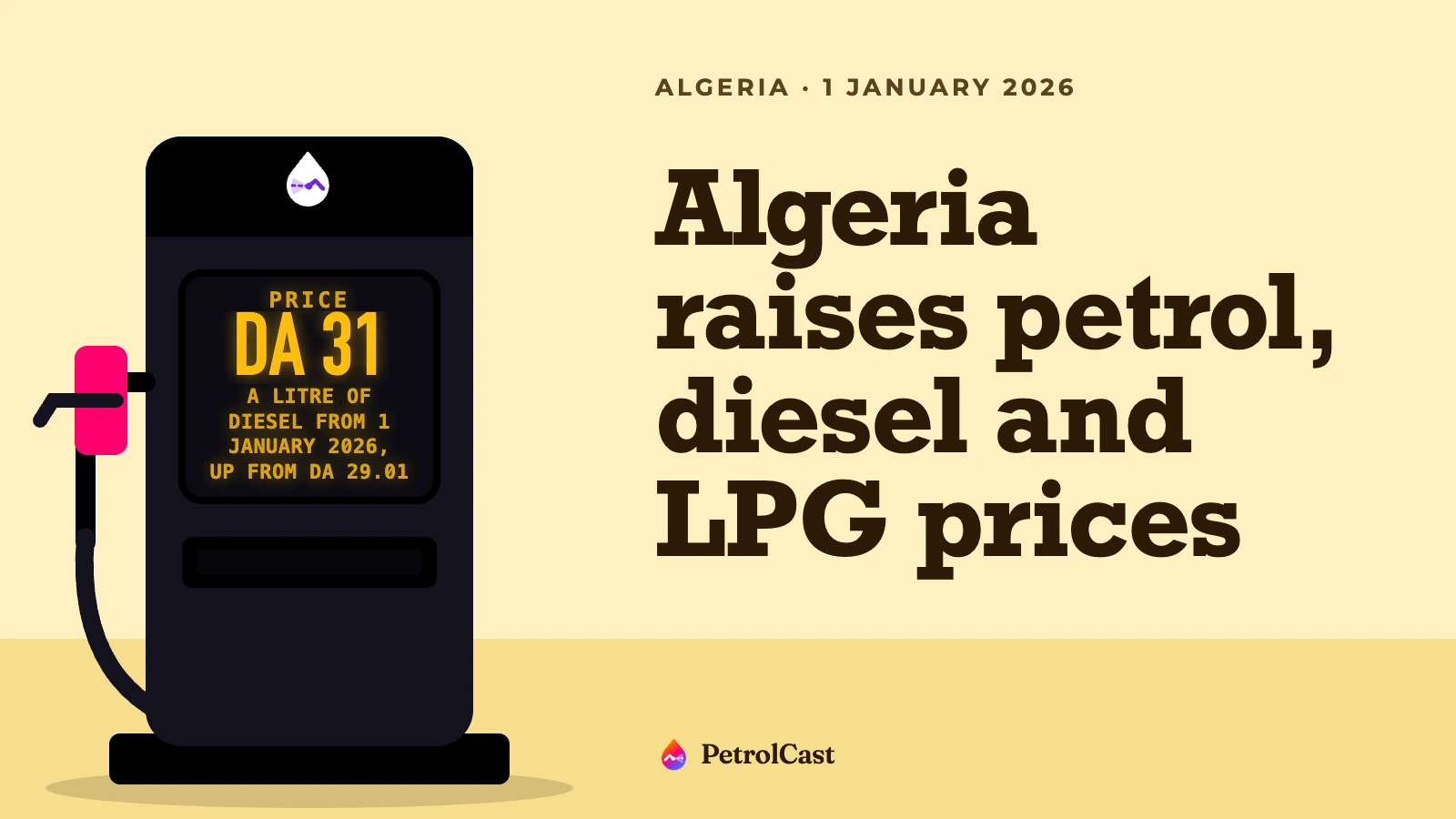
Algeria raises petrol, diesel and LPG prices for 2026
Algeria fuel prices for 2026 took effect on 1 January: petrol DA 47, diesel DA 31 and LPG DA 12 a litre. What changed and what the ministry said.
PetrolCast3 min read
Saudi Arabia raises diesel to SAR 1.79 a litre for 2026
The Saudi diesel price for 2026 rose to SAR 1.79 a litre on 1 January. Why diesel moves once a year, and why petrol and oil prices did not change it.
PetrolCast4 min read
How oil lost $28 in June 2026 as Hormuz reopened
Oil prices fell through June 2026 as an interim US-Iran deal reopened Hormuz. The EIA's Brent spot price, ship counts and pump prices, week by week.
PetrolCast4 min read
Forecasts are estimates for information only, not financial advice.