Brent spot vs futures: why a 13% fall left fuel dear
By PetrolCast5 min read
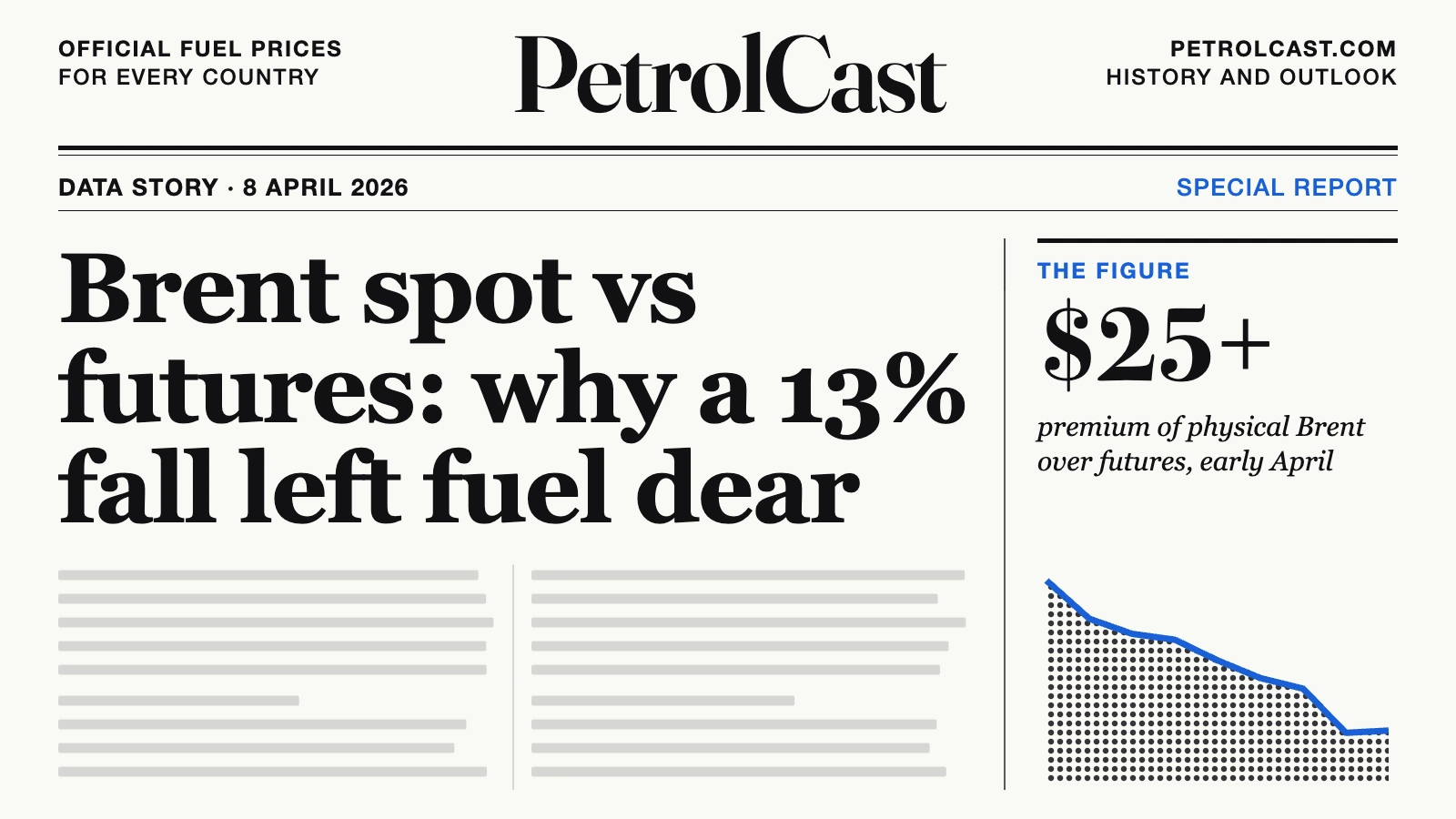
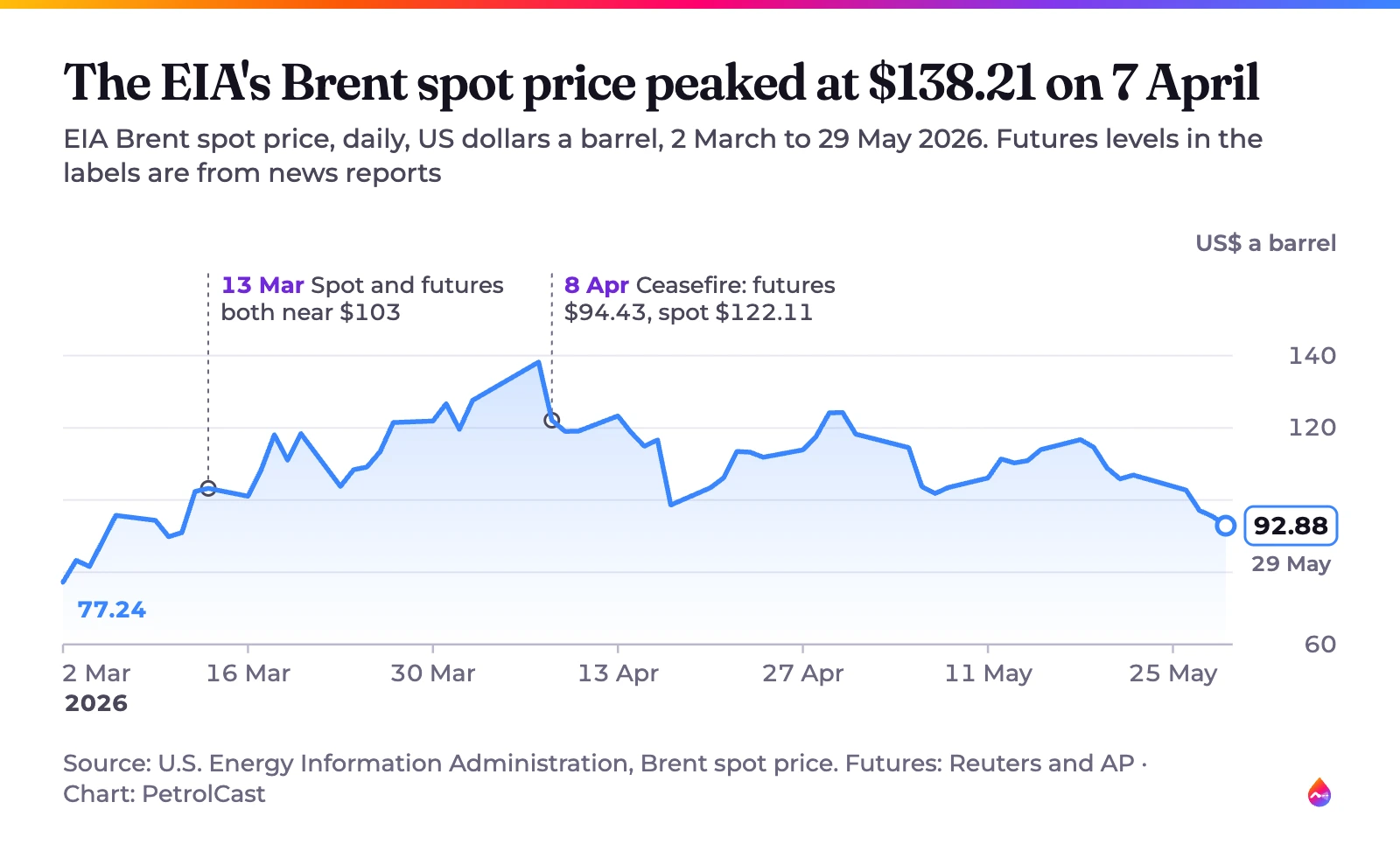
$138.21 a barrel. That was the EIA's Brent spot price on 7 April 2026, the highest of the year. Late that day President Trump agreed a two-week ceasefire with Iran. Pakistan mediated, and the truce was subject to the “immediate and safe reopening” of the Strait of Hormuz. When trading opened on 8 April, Brent futures fell $14.84, or 13.6%, to $94.43, Reuters reported. “Oil drops 14%”, its headline said.
The EIA's spot price for 8 April was $122.11. It had fallen too, by $16.10, but it was still about $28 above the futures price in the headlines. Both numbers are called Brent, and on most days nobody needs to tell them apart. In April 2026 the difference was more than a quarter of the futures price. This is what each one measures, why they split, and which one your fuel bill follows.
Two prices with one name
Brent futures are contracts, traded on the Intercontinental Exchange (ICE), to buy or sell oil for delivery in a later month. The front-month contract is the nearest month still trading. In April 2026 that was the contract for June delivery. So many of these contracts change hands that the front-month price is the most widely used measure of Brent, the EIA says. It is the price on financial websites and in almost every news report.
The spot price is the price of real oil, now. Dated Brent is the price of a specific cargo loading at North Sea terminals on a given date, for near-immediate delivery, and price reporting agencies assess it every day. Refiners buying cargoes to process in the coming weeks pay physical prices like this one. The EIA publishes its own daily Brent spot price, and that is the series on our charts.
In normal times the two sit close together. The EIA says the gap between Dated Brent and the front-month future is usually narrow and tends to be positive, a state traders call backwardation, in which a barrel today is worth a little more than a barrel in two months.
Why the gap blew open
Think of two ferry tickets on the same route. One is for the boat leaving this afternoon, the other for a boat two months from now. If the harbour is suddenly mobbed, this afternoon's ticket shoots up, because there is only one boat and everyone needs to be on it. The two-month ticket rises only as much as people expect the crowd to last.
That is what happened in April. With the Strait of Hormuz shut, refiners that had lost their Gulf cargoes were competing for any crude they could load soon. The EIA put it down to “extreme market tightness in the very short term” since the strait closed, and said the scramble showed up more in spot prices than in futures, which price later delivery. In early April Dated Brent traded at a premium of more than $25 a barrel over the front-month future, the EIA said, and Bloomberg reported a record for Dated Brent on 7 April.
The ceasefire was news about the coming weeks and months, which is exactly what futures price, so futures fell hard. It did not put more oil on ships that week. Within days Iran restricted traffic in the strait again over fighting in Lebanon, which it said breached the ceasefire, AP reported. The EIA's spot price was still $119.07 on 10 April and $123.28 on 13 April.
The gap through the year
The table sets the futures prices reported in the news on key days of 2026 beside the EIA's spot price for the same day. News reports quote futures at different times of day, so a gap of a dollar or two means little. The big ones are real.
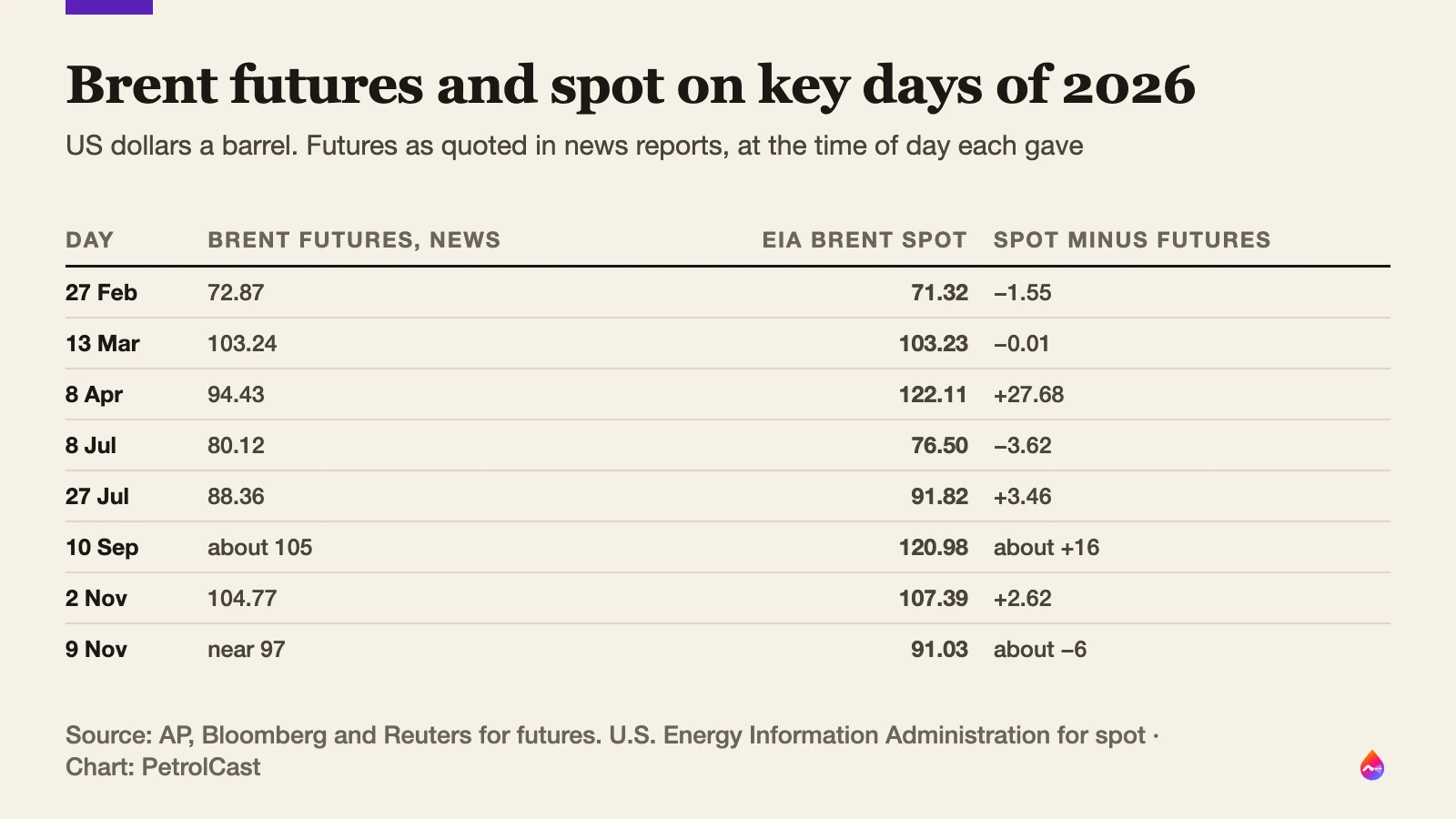
Put side by side, the days show the gap moving with the strait. On 27 February, the last trading day before the war that began on 28 February 2026, when the United States and Israel struck Iran, the two prices were $1.55 apart. On 13 March they were a cent apart. By 8 April spot was about $28 above futures. After the interim deal of June reopened the strait for 60 days, the gap closed, and on 8 July spot was $3.62 below futures. It opened again, to about $16, on 10 September, after that window had lapsed. By 9 November spot was about $6 below futures, the other way round.
What this means at the pump
Refiners pay physical prices for the cargoes they buy, so in April they were paying $25 or more above the futures price in the headlines. That cost went into petrol and diesel, which is why fuel stayed dear after the ceasefire news. It is also why the Brent line on our site, which uses the EIA's spot price, shows higher peaks in 2026 than the prices most news reports quoted.
Our methodology page explains which oil prices we use and why, the compare page shows what drivers paid country by country, and the news page records the days when the two Brents moved apart.
More from the blog
All posts
Algeria raises petrol, diesel and LPG prices for 2026
Algeria fuel prices for 2026 took effect on 1 January: petrol DA 47, diesel DA 31 and LPG DA 12 a litre. What changed and what the ministry said.
PetrolCast3 min read
Saudi Arabia raises diesel to SAR 1.79 a litre for 2026
The Saudi diesel price for 2026 rose to SAR 1.79 a litre on 1 January. Why diesel moves once a year, and why petrol and oil prices did not change it.
PetrolCast4 min read
How oil lost $28 in June 2026 as Hormuz reopened
Oil prices fell through June 2026 as an interim US-Iran deal reopened Hormuz. The EIA's Brent spot price, ship counts and pump prices, week by week.
PetrolCast4 min read
Forecasts are estimates for information only, not financial advice.